

The term “autonomy” names a complex concept that often gets muddled due to variations in meaning in different contexts. To unpack and clarify its definition, Dynamical Systems Group Founder and Chief Engineer Michael Zargham gave a talk, “Disambiguating Autonomy,” in April 2022. Zargham’s talk draws on the book Anarchist Cybernetics: Control and Communication in Radical Politics by Thomas Swann to decompose the concept of autonomy and outlines a common language for designing and validating healthy cybernetic organizations.
This post aims to clarify the important and multifaceted concept of autonomy by breaking it down into two categories and four types. We examine these as relational concepts that have tensions and trade-offs, and consider their context in emergent, self-organizing systems such as internet-native organizations.
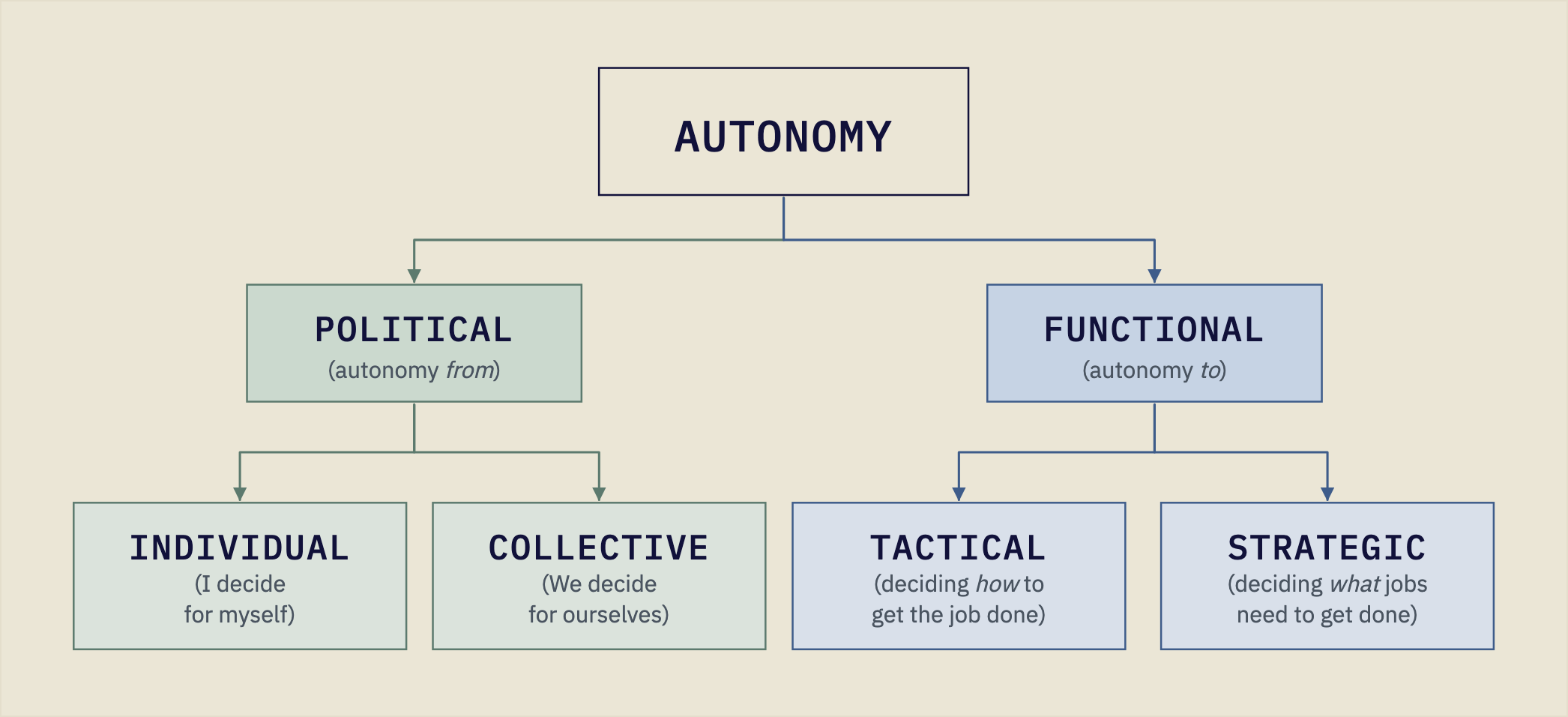
Autonomy is often defined as freedom from external control or influence. In practice, no person or system is free from external influence. The term is thus helpful for exploring the distribution of power among individuals and groups, with an emphasis on where decision-making power is situated and who is impacted by those decisions.
The concept of autonomy can be broken down into two categories: Functional Autonomy and Political Autonomy.
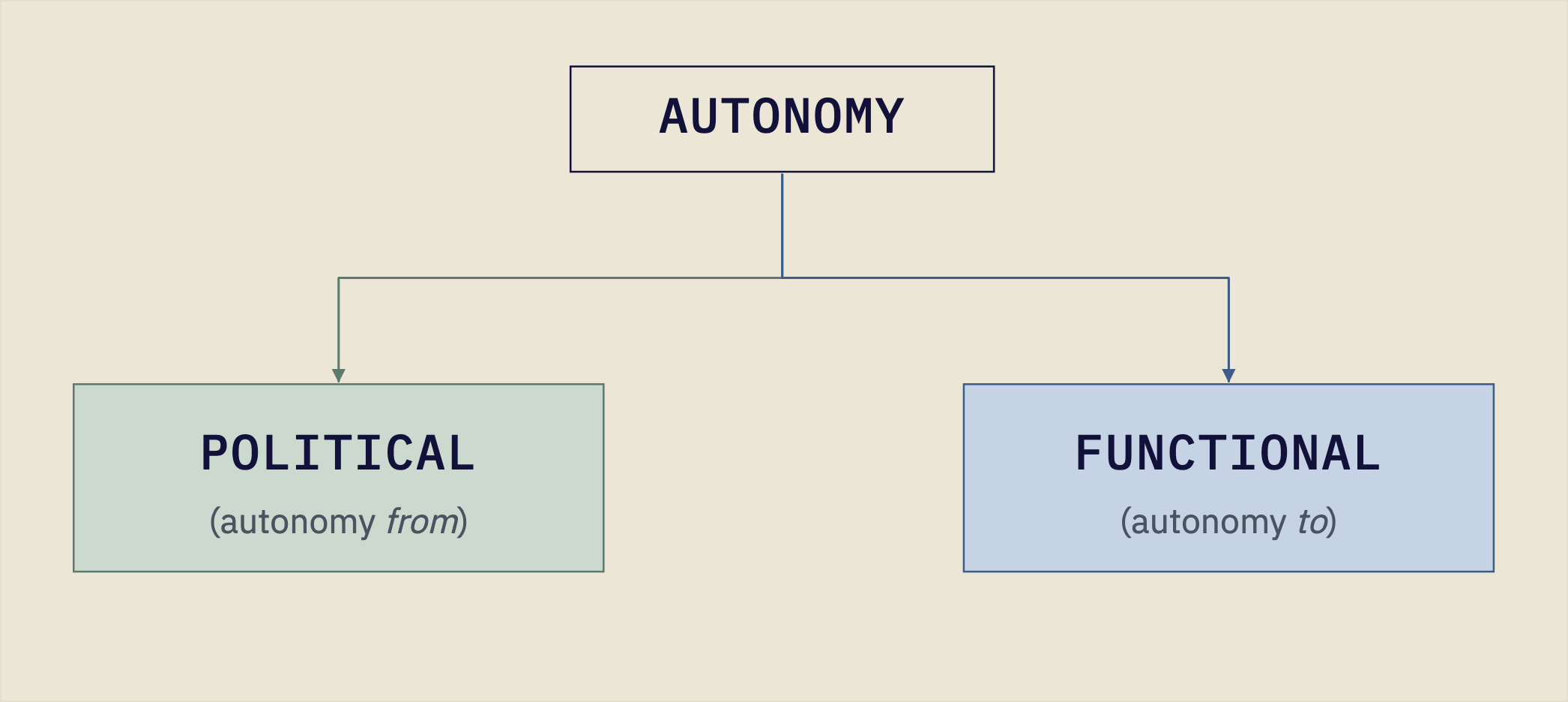
Functional Autonomy is the concept of autonomy that relates to the internal operation of a system, drawn from engineering “autonomous” systems, whereas Political Autonomy is the concept of autonomy as freedom from external political influence, drawn from political science.
Functional Autonomy
Functional Autonomy refers to the degree of flexibility an individual or organization has to respond to complexity pursuant to its goal or function in an operational sense.

Functional Autonomy may be described as the autonomy to do something; it relates to cybernetics and systems theory pioneer William Ross Ashby’s concept of variety, and bears most directly on the actions an individual or group is capable of taking. Building on Thomas Swann’s analysis, we can further distinguish Strategic Autonomy (the freedom to set goals) from Tactical Autonomy (the freedom of action required to achieve goals).
This distinction parallels the principal–agent relation, in which the principal has Strategic Autonomy and the agent has Tactical Autonomy. When it comes to reasoning about the functions, goals, or purposes of organizations, it is important to distinguish the authority to define or refine goals from the degrees of freedom exercised in pursuing those goals.
Political Autonomy
In contrast, Political Autonomy refers to an individual or organization’s authority to make its own decisions without interference by external individuals or organizations, and can thus be considered autonomy from outside forces.
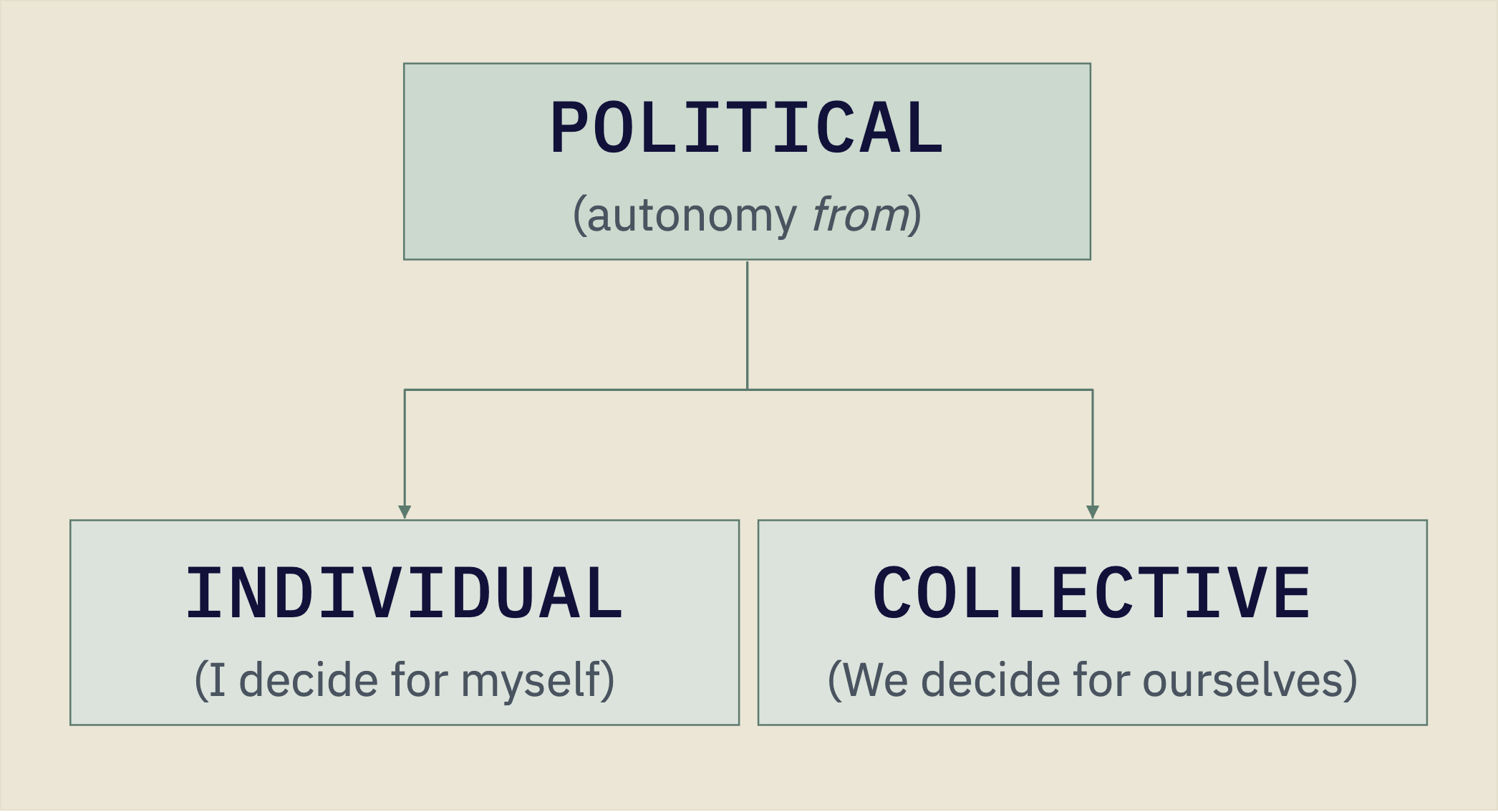
This definition can be confusing because an autonomous organization will nonetheless be made up of constituents with diverse preferences, who can sometimes feel like “outsiders” within the group. Therefore, it is common to discuss autonomy as a relationship between actors (individuals or groups) navigating the boundaries, constraints, and degrees of freedom between them. Relationships within the same scale (individual to individual, or organization to organization) are often easier to reason about. For example, when a teenager becomes an adult, they gain autonomy from their parents; when a colony declares independence, it asserts autonomy from the colonizer.
A multiscale perspective is required to capture interscale effects in emergent, self-organizing systems. The concepts of Individual Autonomy and Collective Autonomy help us to describe interscale relationships (organization to individual, and individual to organization) and their respective trade-offs.
As a member of an organization, an individual accepts a reduction in Individual Autonomy because the organization may place restrictions on its members’ choices (e.g., by making rules or imposing processes). What those members lose in Individual Autonomy may be offset by an increase in Functional Autonomy; at the group level, they may have actions available that were not available to them individually. When a group has the freedom to make decisions about how it will act, according to its own processes, its members have Collective Autonomy.
Coordination among a group of individuals toward a shared purpose necessitates holding tension between Individual and Collective Autonomy. Individuals who are coordinating can be considered part of an organization. For distributed organizations, an effective pattern is to associate Collective Autonomy with Strategic Autonomy and Individual Autonomy with Tactical Autonomy. The group sets goals, policies, and an initial social contract or constitution, while an individual can decide how to pursue those goals within any constraints enforced by the organization.
The Relationship between Political and Functional Autonomy
A general example that demonstrates Tactical versus Strategic Autonomy is an autonomous (self-driving) car. The “autonomous” car has Tactical Autonomy, meaning it can act and make decisions based on its environment. However, the car does not (and should not) have the ability to decide on its destination. The destination should be the decision of the passenger, which means the passenger has Strategic Autonomy.
In the context of cybernetic organizations, Strategic Autonomy is the ability to determine the primary goals of the organization (and the performance metrics that show whether those goals have been or are being achieved), as well as budgets, compensation, and policy. Policy and rule setting includes, but is not limited to, processes enshrined in self-executing code. In such an organization, the group exercises Collective Autonomy to make key decisions about matters such as resource allocation, algorithmic policy, or the parameters of its economic rules.
Once goals have been established by the collective, members of an organization have the freedom to act within the constraints set, and have Tactical Autonomy: the discretion to pursue the group-level goals according to their preferences. As long as a member keeps to the budgets, compensation, performance metrics, and/or rules set forth (some of which may be algorithmically enforced), that member has Individual Autonomy. While members are bound to act within these constraints over short time horizons, there are also mechanisms through which members adapt those constraints in future cycles or seasons.

The exercise of Collective Autonomy to make group-level decisions is Governance, and the application of Individual Autonomy to get things done is Operations.
Governance tends to evolve slowly and should provide clear expectations for members, whereas Operations move quickly in order to adapt to changes in the environment.
An organization with Operations but no explicit governance structure tends to fall into informal, unacknowledged, and unaccountable implicit governance structures (what feminist literature calls the tyranny of structurelessness) or simply to disperse with the fleeting attention of its erstwhile participants. An organization with Governance but no Operations can be an enjoyable social group but cannot actually achieve the goals it sets, a bit like a community-scale “armchair philosopher.”
In organizations whose rules are encoded in software, it is also worth noting that the members of such organizations do not necessarily have a uniform experience of Strategic Autonomy. For example, some members may join after rules are set, and may not yet have access to, or have earned the right to participate directly in, the change process. The level of inclusivity with regard to collective decision-making varies by organization, and there may be different layers of access: Some members may hold the authority to change core rules, while others exercise only Tactical Autonomy.
There is no one-size-fits-all organizational configuration: The specific functions an organization aims to fulfill determine what kinds of governance make sense in practice. In other words, form follows function.
Applying Cybernetics to Governance Research in Self-Organizing Systems
In emerging forms of organization governed by code, the notion of an “autonomous organization” invokes “autonomy” in a nebulous way.
Disambiguating “autonomy” across its two categories (political and functional) and at two scales (group and individual) provides the language required to navigate important trade-offs in organizational structure, especially those between Governance and Operations.
While the expression and dimensions of autonomy within these organizational forms are still being studied, the field of cybernetics, established in the 1940s, offers a valuable lens through which to view them. Cybernetics is the applied social science of control theory and dynamical systems, concerned with “interactions between group-level and individual-level processes, as characterized by purpose-driven systems manifest through self-organization” (Zargham and Nabben 2023). It is a useful field for reasoning about how to engineer mechanisms and institutions through the construction of rules and is being applied by Dynamical Systems Group in its work on programmatic mechanism design, as well as governance research and development for emerging self-organizing systems.
In our earlier work on Stafford Beer’s Viable System Model and the precedents for autonomous organization in cybernetics (Zargham and Nabben 2023), we examined the balance (with respect to purpose) of operational efficiency with the concentration of political power. There, we looked at both the individual and the group scale and determined that the goal of distributed modes of self-organization is operational autonomy (Functional Autonomy) and group-level political autonomy (Collective Autonomy). Here, drawing from the book Anarchist Cybernetics: Control and Communication in Radical Politics by Thomas Swann, we have expounded the two categories and further outlined four types of autonomy and their relational aspects to support more precision and depth in the design and validation of complex organizations.
By examining the four types of autonomy (Tactical, Strategic, Individual, and Collective), how they relate to the existing literature on cybernetics, and how they are expressed in cybernetic organizations, we aim to foster more effective dialogue among those who design and validate healthy and resilient socio-technical systems.
In doing so, we can acknowledge the depth of the topic and understand the relational aspects and trade-offs that exist when designing and analyzing institutions and the construction of their rules. We look forward to continuing research in this domain, documenting and sharing applied learnings from our work, and collaborating with leading experts to further expand the dialogue and improve systems design and analysis in these new and emerging fields.
With thanks to Thomas Swann, whose book Anarchist Cybernetics helped to inform this research, and to Eric Alston for his ideas and citations.
Suggested citation: Zargham, M., Zartler, J., Nabben, K., Goldberg, R., Emmett, J., 2023. “Disambiguating Autonomy: Ceding Control in Favor of Coordination in Cybernetic Organizing.” Available online: https://www.dynamicalsystemsgroup.com/blog/disambiguating-autonomy
About Dynamical Systems Group
Dynamical Systems Group is a systems engineering firm that operationalizes emerging technology for high-reliability organizations. We combine academic-grade research with advanced mathematical and computational engineering to design safe and resilient socio-technical systems.
This version has been edited since its initial publication, and its figures have been redrawn.
Fig. 1 by Michael Zargham & Jeff Emmett